
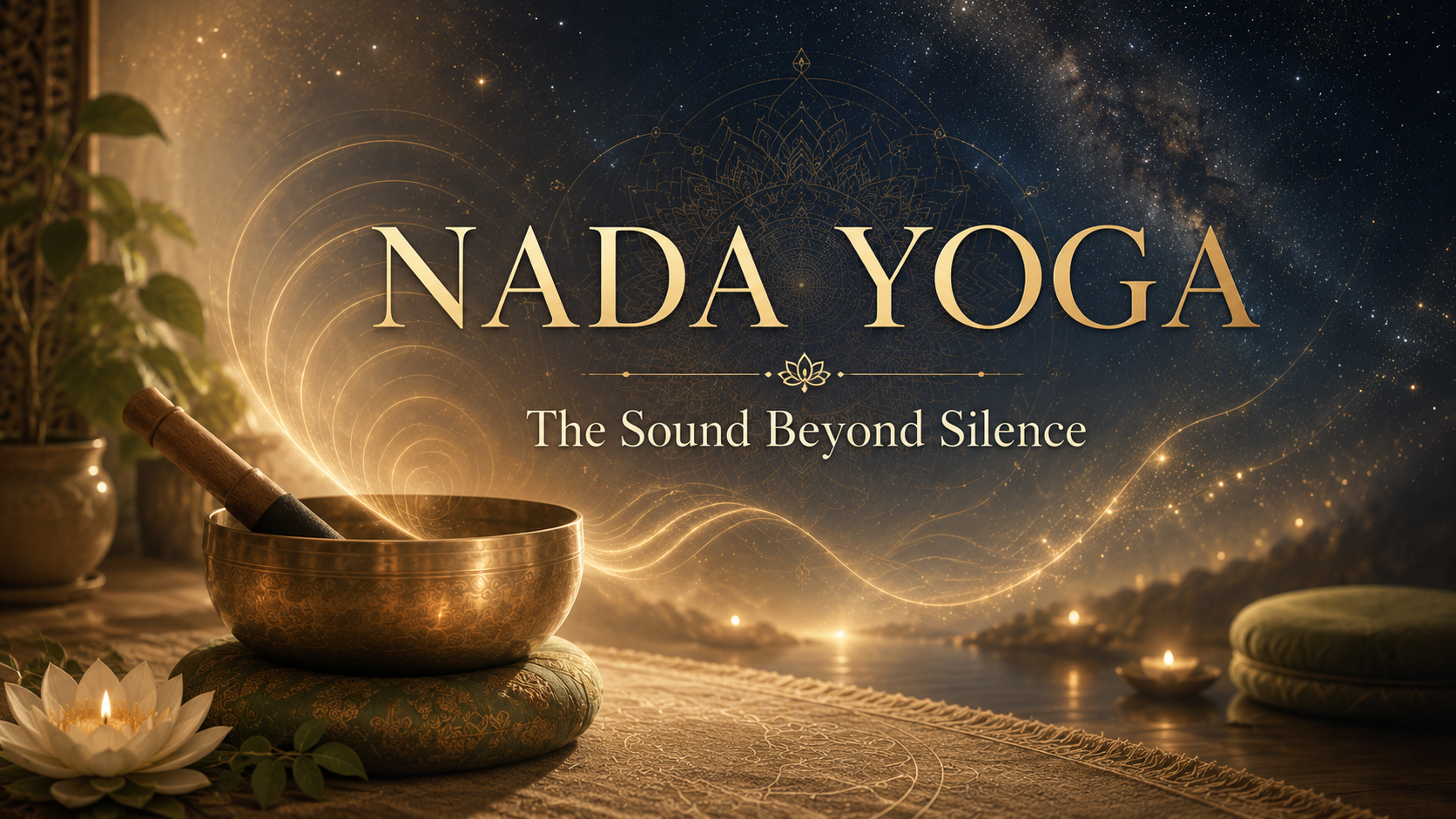
Before the world took form, before matter condensed into stars, planets, and life, there was vibration.
Not sound as we hear it through the ears. Not noise carried through air. But pure frequency – the subtle movement behind all existence.
The ancient yogis called this Nada: the primal resonance from which creation unfolds. In the vast silence of the cosmic womb, Nada was understood as the first breath of creation, the eternal tone behind all movement and all being.
Long before modern science described the universe as energy moving in patterns, the yogis of India sat in stillness and listened. Not only with the ears, but with consciousness.
What Is Nada Yoga?
Nada Yoga is the yoga of sound and silence.
It is not simply music, chanting, or mantra, though it may include all three. At its heart, Nada Yoga is the art of tuning the mind to the subtle frequencies beneath thought, emotion, and perception.
The yogis taught that there are two kinds of sound:
- Ahata Nada: the struck sound. This is sound created by contact, such as speech, music, singing bowls, wind, bells, or the rustle of leaves.
- Anahata Nada: the unstruck sound. This is the inner sound, the subtle resonance that arises without external contact.
Ahata sound is heard by the ears. Anahata sound is known by the being.
In Nada Yoga, the practitioner begins with outer sound and gradually turns inward. Through breath, stillness, focus, and deep listening, attention moves beyond surface noise into a quieter field of awareness.
To hear the inner sound is to touch the soul. To follow it is to return to source.
Listening Beneath the Noise
The inner Nada has been described for centuries by mystics, yogis, and contemplatives across traditions. Some describe it as a high ringing, like a bell heard in silence. Others experience it as a flute, a deep hum, distant thunder, or a subtle vibration moving through the body.
In Nada Yoga, this sound becomes the object of meditation.
As the practitioner settles, the outer senses soften. The breath becomes quieter. The mind begins to release its grip on words, images, and distractions. Beneath the movement of thought, a deeper current can be felt.
This current is not heard in the ordinary way. It is perceived as presence.
If you have ever felt the quiet between thoughts, the moment when breath pauses and awareness deepens, you have touched the doorway to Nada.
The Body as an Instrument
Modern science gives us a helpful language for understanding what ancient practitioners already intuited: everything vibrates.
From subatomic particles to galaxies, the universe is alive with movement. Our bodies are also instruments of frequency. Every breath, heartbeat, organ rhythm, emotional state, and thought pattern carries a vibration.
The brain itself moves through frequency states, often described as delta, theta, alpha, beta, and gamma. Ancient yogic science maps the inner system differently, through chakras, nadis, prana, and subtle centers. Though the languages differ, both point toward the same mystery: the human being is not a fixed object, but a living field of resonance.
Through Nada Yoga, we learn to become sensitive to this inner field.
The purpose is not to create noise. The purpose is to listen so deeply that the body, mind, and spirit begin to remember harmony.
From Sound Into Silence
In many sound practices, the journey begins with something external:
- the breath
- a mantra
- a singing bowl
- a bell
- the voice
- an instrument such as the tanpura
These outer sounds help gather attention. They steady the mind and give awareness a doorway.
As concentration deepens, the outer sound becomes less important. The practitioner begins to perceive subtler resonance within. This is the movement from Ahata, the struck sound, toward Anahata, the unstruck sound.
The deeper one enters sound, the more one is led into silence.
This is the sacred paradox of Nada Yoga. It is not about chasing sound. It is about dissolving into the silence that contains all sound.
The Power of AUM
Among the sacred sounds of yogic tradition, AUM is often called the sound of the universe.
It represents the merging of waking, dreaming, and deep sleep into pure consciousness. When chanted with awareness, AUM can create resonance through the chest, throat, skull, and abdomen. The vibration may help settle the nervous system, gather the mind, and bring the body into a more coherent state.
But Nada Yoga is not about believing in sound as an idea.
It is about experiencing sound directly. It is about becoming sensitive enough to feel how vibration moves through the body, how silence changes the mind, and how deep listening can open a new quality of presence.
Sound Across Traditions
The practice of sacred listening is not found only in one culture.
In Sufism, sama is a listening practice that opens the heart to the divine. In Tibetan Buddhism, instruments such as the drum and bell carry symbolic and energetic meaning. In Christian mysticism, saints and contemplatives have spoken of celestial harmonies heard in deep prayer.
Across traditions, when consciousness deepens, sound often appears.
Not as distraction, but as calling.
Sound Has Shape
Sound does not only move through the ear. It shapes matter.
Cymatics, the study of visible sound and vibration, shows how frequency can organize sand, water, and other mediums into patterns. Under vibration, matter may form waves, spirals, or geometric designs.
The same principle can be contemplated inwardly.
Every thought carries a tone. Every emotion has a rhythm. Our inner world is a soundscape. Nada Yoga teaches us to listen not only to external sound, but to the architecture of our own being.
To an untrained ear, silence may feel empty. To the Nada Yogi, silence is full. It vibrates. It sings. It holds tones too subtle for ordinary hearing.
The Four Movements of Nada Practice
Some teachings describe the journey of Nada Yoga in progressive stages:
- External sound: the practitioner begins with struck sound, such as voice, breath, mantra, or instrument.
- Subtle sound: attention turns inward and a quiet inner hum or tone may be perceived.
- Merging: sound and awareness become less separate. The listener, the listening, and the sound begin to feel like one field.
- Dissolution: even sound falls away, and only silent presence remains.
This final stillness is sometimes connected to Turiya, the fourth state of consciousness beyond waking, dreaming, and deep sleep.
It is not an experience in the ordinary sense. It is a quiet, living awareness beyond the usual movement of the mind.
Why Nada Yoga Matters Today
Modern life is not kind to silence.
We are surrounded by constant input: devices, traffic, conversations, notifications, artificial sound, and mental pressure. The inner ear becomes tired. The mind forgets how to listen inwardly.
Nada Yoga offers a return.
It is not an escape from life. It is a return to center. It asks us to remove what is noisy, forced, and unnecessary so we can hear what was always present beneath it.
The sound of Nada is not something we create. It is something we discover.
It is already present, like a subtle background note in the symphony of life. To hear it, we quiet the other instruments.
Sound Healing and Nada Yoga
Modern sound therapy, singing bowls, binaural beats, and neuro-acoustic tools can support relaxation and mindfulness. They may help the body settle and give the mind a clear object of attention.
But in the deeper tradition of Nada Yoga, sound is not only a tool. It is a path.
Outer sound prepares the listener. Inner sound reveals the listener.
This is why a guided sound healing session can become more than a relaxing experience. When held with intention, breath, and awareness, sound can become a bridge from mental noise into inner stillness.
A Simple Practice: Listen Beyond Sound
You can begin gently.
Find a quiet place. Sit comfortably. Let the spine soften but remain awake. Close your eyes.
Take a few slow breaths through the nose. Allow the body to settle.
First, notice external sound. Do not judge it. Let every sound arrive and pass.
Then listen beneath the sound.
Notice the quiet after each breath. Notice the space between thoughts. Notice whether a subtle hum, tone, vibration, or stillness begins to appear.
Do not chase it. Do not force it.
Just listen.
Not only with your ears, but with your whole being.
Returning to the Soundless Sound
Nada Yoga is not about becoming someone else. It is about remembering who you are beneath the noise.
Beneath identity, beneath thought, beneath the constant movement of the world, there is a deeper resonance. It has no beginning and no end. It does not speak in words, but in knowing.
To dwell in that sound is to know peace not as a passing mood, but as a ground of being.
This is the heart of Nada Yoga:
to listen beyond sound,
to awaken in silence,
and to return to the eternal resonance within.
Event Invitation
Experience this path through a guided session with Guru Krissy Gee, a Psychic and Sound healer with 28 years of experience in the healing arts.
Sound Healing Through Nada Yoga
Date: Sunday, 31 May 2026
Time: 1:00 PM-3:00 PM
Venue: Bodhi Heart Sanctuary
Registration: Guru Krissy Gee +60 17 659 6933
Come with an open heart, a quiet intention, and a willingness to listen inwardly.